
How to Recover When You Break a Habit Streak
Tend Team
Published April 1, 2026
5 min read
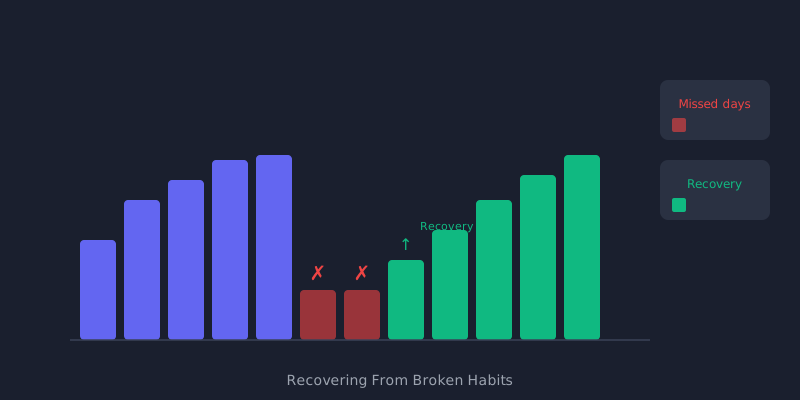
You missed a day. Maybe two. The streak is broken, and there is a familiar feeling: the slow deflation of effort that seemed to matter. Most people quietly close their habit tracker and stop using it. This article is about why that response is the actual mistake — and how to recover instead.
The All-or-Nothing Trap
The most dangerous thought after breaking a habit streak is: "I've already failed, so there's no point continuing."
This is called the all-or-nothing fallacy, and it is responsible for more abandoned habits than any other single factor. It treats habit-building like a fragile object: perfectly intact or completely broken, with no middle state.
But habits are not fragile objects. They are patterns in neural architecture, and those patterns do not evaporate because you missed a day. The 30 days of consistent practice you completed before missing a day are still there — in your brain, in your body, in your automatic responses.
The research: A 2010 study by Phillippa Lally at University College London found that missing a single day had no statistically significant effect on the ultimate formation of the habit. The streak matters; the occasional gap does not.
Missing Once vs. Missing Twice
There is a meaningful distinction between missing one day and missing two.
Missing once is an accident. It happens because of illness, unexpected circumstances, travel, or simply an overwhelming day. It does not represent a change in your intentions or your identity.
Missing twice begins to establish a new pattern. The second missed day often comes with a rationalization: "I've already broken it, so one more day doesn't matter." This is the moment when an accident becomes a habit — the habit of not doing the thing you intended to do.
The rule: Never miss twice. This single guideline prevents most streak-abandonment spirals. It does not require perfection; it requires getting back on the day after a miss.
What Self-Compassion Research Says
There is a counterintuitive finding in psychology research on self-regulation: self-criticism after failure predicts worse future performance, while self-compassion predicts better recovery.
Kristin Neff's research on self-compassion shows that people who treat themselves kindly after setbacks are more likely to try again, adjust their approach, and ultimately succeed than people who harshly criticize themselves.
The mechanism: self-criticism activates the threat response, which narrows cognitive attention and reduces the psychological safety needed to take risks. Self-compassion activates the care system, which supports exploration, learning, and persistence.
Applied to habits: treating yourself with understanding after a missed day actually makes you more likely to get back on track than lecturing yourself about discipline.
Recovery Rituals
A recovery ritual is a defined process you follow when a streak breaks. Having a procedure removes the need to make decisions in a moment when motivation is already low.
The Simple Recovery Protocol
- Acknowledge without dramatizing. "I missed yesterday. That happens."
- Identify the cause without blame. "I was sick / overwhelmed / traveling / just didn't."
- Recommit concretely. "Today I will do [the minimum viable version of the habit]."
- Do it. Not the full version. The minimum version. Just get a checkmark.
- Track the restart as a win. Day one of the new streak is worth celebrating.
The Reset Mindset
Some people find it helpful to think of a broken streak not as a failure but as a reset — a return to the beginning, which is where all progress starts. Beginnings are opportunities, not defeats.
If you have completed 45 days and miss one, you are not back at zero. You are a person with 45 days of evidence who is starting day one of the next run. That person is fundamentally different from the person who started the original 45-day streak.
Building Resilience Into Your System
The most robust habit systems are designed for recovery, not just consistency.
Build a Minimum Viable Behavior
For every habit, define the smallest version that still counts as completing it:
- Full workout: 30 minutes / Minimum: 10 minutes of movement
- Journaling: 3 pages / Minimum: one sentence
- Reading: 30 minutes / Minimum: read one paragraph
On hard days, do the minimum. It maintains the identity and the streak without requiring you to summon reserves you do not have.
Designate Flex Days
Some systems allow one "flex" or "rest" day per week that does not break the streak. This is particularly valuable for physically demanding habits where rest is part of the protocol. Knowing you have a flex day reduces the anxiety of impending schedule conflicts.
Track Completion Rate, Not Just Streak Length
A complementary metric is your 30-day completion rate. Completing a habit 27 out of 30 days (90%) is excellent by any measure, even if it contains a three-day gap that broke the streak. Adding a rate metric alongside streak length gives you a more complete picture of your consistency.
The broken streak is not the enemy of habit formation — the decision not to restart is. Recovery is not a setback in the habit-building process; it is part of it. Every person who has built lasting habits has also recovered from broken streaks. The practice of recovery, done well, is itself a habit worth building.