
The Science of Habit Formation
Tend Team
Published February 1, 2026
8 min read
We all know we should build better habits. But most advice about how to do it is based more on popular mythology than actual science. Let's look at what research tells us about how habits really form.
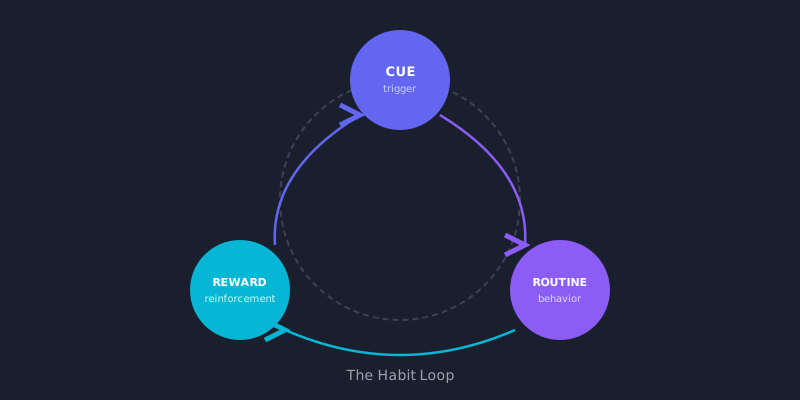
The Habit Loop: Cue, Routine, Reward
The most durable framework from habit science comes from MIT researcher Ann Graybiel, later popularized by Charles Duhigg. All habitual behaviors follow a three-part loop:
Cue: An environmental trigger that signals the brain to enter habit mode. Cues can be times of day, locations, emotional states, other people, or preceding actions.
Routine: The behavior itself — the physical, mental, or emotional sequence that unfolds automatically in response to the cue.
Reward: The positive outcome that reinforces the loop and makes the brain want to repeat it.
Key insight: You cannot simply decide to stop a habit. The cue-routine-reward loop is encoded in the basal ganglia, a brain structure that operates independently of conscious thought. To change a habit, you need to understand the loop and intervene deliberately.
Neuroplasticity and Repetition
The brain is physically changed by experience. When neurons fire together repeatedly, the connections between them strengthen — a principle summarized as "neurons that fire together, wire together."
More specifically, repeated activation of a neural pathway triggers myelination: the wrapping of the axons in a fatty insulating sheath. Myelinated pathways transmit signals up to 100 times faster. This is why practiced behaviors feel effortless while new behaviors feel laborious.
What This Means for Habit Building
Every repetition of a new behavior is a small physical change in your brain. The discomfort of building a new habit is literally neurological — you are asking your brain to use pathways that are not yet efficient.
Consistency is not just psychological; it is biological. You cannot shortcut the process. You can only make it more reliable.
Why the 21-Day Myth Persists
"It takes 21 days to form a habit" is one of the most repeated pieces of behavioral advice in popular culture. It is also largely wrong.
The 21-day claim traces back to a 1960 book by plastic surgeon Maxwell Maltz, who noticed that amputees took about 21 days to stop feeling phantom limb sensations. He extrapolated — loosely — to behavioral change. The claim spread because it was optimistic and specific.
What Research Actually Says
The most cited scientific study on habit formation timelines was published by Phillippa Lally and colleagues at University College London in 2010. They followed 96 participants trying to build new habits and found:
- It took 18 to 254 days for a new behavior to become automatic
- The average was 66 days — more than three times the popular claim
- Complexity of the behavior mattered: drinking a glass of water at breakfast automated faster than doing 50 sit-ups after breakfast
- Missing a single day had no significant effect on ultimate habit formation
The takeaway: Plan for at least two months, not three weeks. Complexity matters. And missing one day is completely fine.
The Role of the Basal Ganglia
When a behavior becomes habitual, control shifts from the prefrontal cortex (conscious, deliberate decision-making) to the basal ganglia (automatic, pattern-based processing).
This transfer is why habits feel automatic — because they literally are. The prefrontal cortex is no longer involved.
This also explains why habits are so hard to break even when we consciously want to: the basal ganglia keeps triggering the routine in response to the cue, regardless of what the prefrontal cortex intends.
How to Use Science in Practice
Stack on Existing Triggers
Use existing behaviors as cues for new ones. If you already make coffee every morning, that activity is a reliable cue for a new habit. "After I start the coffee maker, I will write three things I'm grateful for" uses an existing neural pathway as scaffolding.
Reward Immediately
The reward must follow the behavior closely — ideally within seconds. Distant rewards (being healthy in six months) do not reinforce the loop effectively. Immediate rewards (a feeling of pride, a checkmark in a tracker, a favorite song) work much better.
Reduce Friction Aggressively
Friction is the enemy of habit formation. Every obstacle between you and the behavior increases the likelihood that the cue will not successfully trigger the routine. Put your running shoes by the door. Put your journal on your pillow. Put the healthy snacks at eye level. Remove as many obstacles as possible.
Track Streaks
Visual streak tracking provides an ongoing source of immediate reward. The desire to maintain a streak ("don't break the chain") activates the same reward circuitry as other reinforcers. This is why habit tracker apps work — they add an artificial but genuinely effective reward structure to behaviors that might otherwise lack immediate feedback.
The science is clear: habits form through repetition, not willpower. Understanding the cue-routine-reward loop, planning for the real timeline, and designing your environment for success gives you a significant advantage over the vast majority of people who rely on motivation alone.